How to do the lunge
Stand tall, then take a long step forward and lower your back knee toward the floor until both knees are bent about 90 degrees. Push through your front foot to step back to the start, or step through into the next lunge if you are walking.
How to do the lunge, step by step
- Stand with your feet hip-width apart, holding dumbbells at your sides if you use them.
- Take a long step forward.
- Lower your back knee straight down until it nearly touches the floor.
- Keep your torso upright and your front knee over your foot.
- Push through your front foot to return, or bring the back foot through to walk into the next rep.
Form cues
- Long steps, upright torso.
- Back knee drops straight down.
- Front heel stays on the floor.
Common mistakes
- Steps so short that the front knee shoots far forward and the heel lifts.
- Banging the back knee on the floor.
- Feet in a straight line, like a tightrope, which ruins balance.
Muscles worked
| Role | Muscle group | Muscles in the group |
|---|---|---|
| Primary | Quads | quadriceps |
| Secondary | Glutes | gluteus maximus, medius and minimus |
Lunges work the quadriceps and glutes, with the hamstrings, adductors and calves assisting. Walking lunges and reverse lunges load the glutes a little more than forward lunges.
Equipment and difficulty
Equipment: dumbbell, bodyweight. Level: beginner. Easy to learn and load safely.
Sets and reps
| Goal | Sets × reps | Rest |
|---|---|---|
| Beginner | 3 × 8-10 per leg | 60-90 s |
| Strength | 3-4 × 6-8 per leg | 2 min |
| Muscle size | 3 × 10-15 per leg | 90 s |
End most sets one to three reps short of failure, and count the lunge toward the 10 to 20 hard sets a week that most people do for each muscle. More on sets and reps and rest between sets.
Starting weight
Start with bodyweight. Once 12 steady reps per leg are easy, hold 10 to 25 lb dumbbells.
Add weight with progressive overload: once every set reaches the top of your rep range, take the smallest jump available.
Alternatives to the lunge
- Split squat: The same single-leg squat movement; needs no equipment.
- Bulgarian split squat: The same single-leg squat movement with dumbbells.
- Step-up: The same single-leg squat movement with dumbbells.
- Back squat: Also trains the quads, with a barbell.
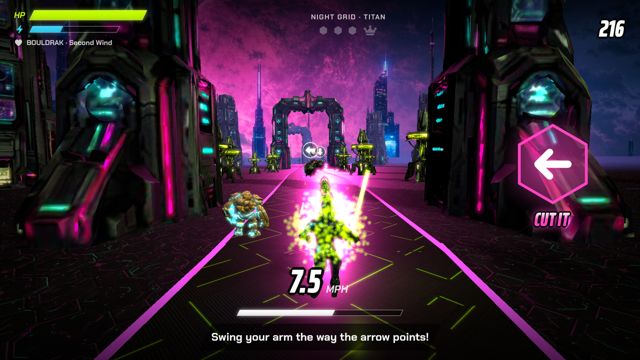
Your phone is the weight and the sword. Curls, squats and presses land hits on screen, and you swing the phone to slash. Fight and capture twelve creatures across four worlds, and AirPlay it to your TV. Free.
More exercises
Questions
What muscles does the lunge work?
Lunges work the quadriceps and glutes, with the hamstrings, adductors and calves assisting. Walking lunges and reverse lunges load the glutes a little more than forward lunges.
Forward, reverse or walking lunges?
Reverse lunges, stepping back, are the easiest on the knees and to balance. Forward lunges involve braking, which loads the front knee more. Walking lunges combine both and need space. All train the same muscles.
Lunges vs squats?
Squats let you load more weight on both legs. Lunges train one leg at a time, which builds balance and evens out differences between legs. Most programs include both.
What can I do instead of the lunge?
Good substitutes: split squat (the same single-leg squat movement; needs no equipment); Bulgarian split squat (the same single-leg squat movement with dumbbells); step-up (the same single-leg squat movement with dumbbells); back squat (also trains the quads, with a barbell).