How to do the front squat
Rest the bar across the front of your shoulders with your elbows pointed forward and high, in a clean grip or with your arms crossed. Squat straight down, keeping your torso upright and elbows up, until your hips are below your knees, then stand back up.
How to do the front squat, step by step
- Set the bar in the rack at upper-chest height.
- Step in so the bar sits on the front of your shoulders against your throat.
- Hold it with fingertips in a clean grip just outside the shoulders, or cross your arms over it.
- Lift your elbows until your upper arms are about parallel to the floor, then unrack and step back.
- Brace and squat straight down, keeping your torso upright.
- Stand up by driving your elbows up and your feet into the floor.
Form cues
- Elbows high, all the time.
- Torso stays upright; the bar rests on the shoulders, not the hands.
- Sit straight down between your heels.
Common mistakes
- Elbows dropping, which rolls the bar forward.
- Holding the bar up with the hands and straining the wrists.
- Leaning forward out of the bottom.
Muscles worked
| Role | Muscle group | Muscles in the group |
|---|---|---|
| Primary | Quads | quadriceps |
| Secondary | Glutes | gluteus maximus, medius and minimus |
| Secondary | Abs and core | rectus abdominis, obliques and deep core muscles |
The front squat works the quadriceps and glutes, with the upper back and abs working hard to keep the torso upright. Research comparing the two squats found similar muscle activity with less compressive force at the knee for the front squat at a lower load.
Equipment and difficulty
Equipment: barbell. You also need a squat rack with safety pins or arms. Level: intermediate. Worth learning once the basic lifts feel steady.
Sets and reps
| Goal | Sets × reps | Rest |
|---|---|---|
| Beginner | 3 × 8-10 | 2 min |
| Strength | 3-5 × 3-6 | 3-5 min |
| Muscle size | 3-4 × 6-10 | 2-3 min |
End most sets one to three reps short of failure, and count the front squat toward the 10 to 20 hard sets a week that most people do for each muscle. More on sets and reps and rest between sets.
Starting weight
Start with the empty bar. Most lifters front squat about 70 to 85 percent of their back squat.
Add weight with progressive overload: once every set reaches the top of your rep range, take the smallest jump available.
Alternatives to the front squat
- Goblet squat: Dumbbell option: the same squat movement with dumbbells, and easier to learn.
- Bodyweight squat: Home option: the same squat movement; needs no equipment, and easier to learn.
- Leg press: The same squat movement with a machine, and easier to learn.
- Hack squat: The same squat movement with a machine, and easier to learn.
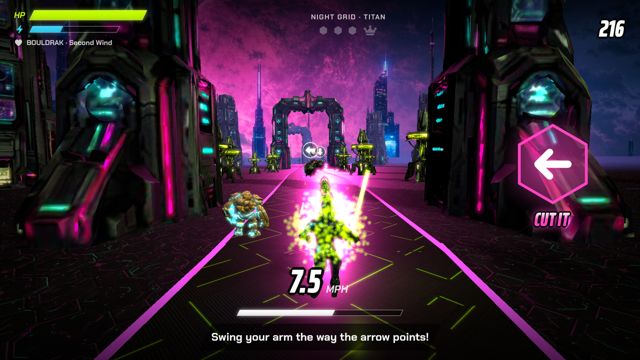
Your phone is the weight and the sword. Curls, squats and presses land hits on screen, and you swing the phone to slash. Fight and capture twelve creatures across four worlds, and AirPlay it to your TV. Free.
More exercises
Questions
What muscles does the front squat work?
The front squat works the quadriceps and glutes, with the upper back and abs working hard to keep the torso upright. Research comparing the two squats found similar muscle activity with less compressive force at the knee for the front squat at a lower load.
Front squat vs back squat?
The front squat keeps the torso more upright, emphasizes the quads and abs, and uses less weight. The back squat lets you lift more and works the glutes and hips more. Both build the legs; many programs pick one as the main squat.
How do I stop my wrists hurting in front squats?
Hold the bar with only the fingertips, or use straps wrapped around the bar as handles, or cross your arms. The bar should rest on the shoulders, with the hands only keeping it in place.
What can I do instead of the front squat?
Good substitutes: goblet squat (dumbbell option, the same squat movement with dumbbells, and easier to learn); bodyweight squat (home option, the same squat movement; needs no equipment, and easier to learn); leg press (the same squat movement with a machine, and easier to learn); hack squat (the same squat movement with a machine, and easier to learn).